

Wondering if solar panels in Spain are worth the cost?
Check these results from solar installations carried out by Marblanc Solar this year:
- Rural property in Estepona: Annual saving of €950
- Holiday home in Benalmádena: Annual saving of €1,800
- New-build villa in Manilva: Annual saving of €2,774
- Luxury finca in Mijas: Annual saving of €3,800
- Modern villa in Marbella: Annual saving of €4,052
For all the installations above, the client will break even on the cost of their solar panel installation within 3-5 years. After that, it’s pure savings and a boosted property value for the 25 years their system remains under warranty.
But this isn’t the case for everyone.
Unfortunately, we’ve seen many homeowners sold solar power systems that fail to deliver.
In this guide, we’ll walk you through a shocking case study, detail the itemised costs of solar installations in Spain, and give you 4 tips to maximise your long-term savings.
Want an Instant Cost Estimation?
Want to save time figuring out your own expected solar installation cost?
In 1-2 minutes, our online solar calculator will estimate your:
Installation cost
Annual electricity savings for the next 10 years
Break-even period
Click below to get started.
Solar calculatorCase study
How a Faulty Installation Left Marbella Homeowner Overpaying €240 on Bills Every Month
Last year, a Marbella homeowner contacted us worried they’d been mis-sold.
Their solar panels had cut the monthly bill from €800 down to €400. But the client was promised a bill of around €160.
The original installer had stopped returning calls. So the client searched online and contacted Marblanc Solar for a second opinion.
What Was Wrong With the System
Upon inspection by our co-owner and qualified electrician, Adam Millington, we found the following problems:
- Inverter clipping – The installation had too many solar panels for the size of the solar inverter, which meant the electricity production was “clipped” before reaching maximum output.
- No virtual battery – The installation had never been registered, meaning the client couldn’t get a virtual battery deal and store excess solar power as credit.
- High nighttime usage – The property had a pool pump and heater running at night and buying significant electricity from the grid.
- Inadequate cabling – The installation used cables too small to carry the electrical current. They were underperforming and creating a fire hazard.
- No post-installation support agreement – No after-care was promised in the purchase agreement, and the installer had stopped returning calls.
How We Fixed It
Unfortunately for the client, the best solution was to rip out the faulty wiring and inverter and install a new system. We went ahead and legalised the new system, before moving the client immediately to a virtual battery deal.
We then monitored consumption for two weeks via a solar app, and fitted plug timers to limit night-time consumption.
The result?
The client’s bill dropped to €160 as originally promised.
Sadly, this kind of situation is common with solar panel installations in Spain. Just two months ago, we alerted Sur in English after inspecting another unregistered system – this one with a circuit breaker so badly melted it was weeks away from a potential house fire.

In June 2025, we contacted local news media after finding a melted circuit breaker (not our own) to inform homeowners about the correct cable sizes for solar panel systems in Spain.
How This Lesson Can Protect You From Costly Solar Mistakes
Shocking case studies like these motivated me to change our quoting process at Marblanc Solar.
Let’s look at how we used to do it.
Solar companies know that a homeowner will get three to five quotes from different companies. There’s competition. So they enter into a price war, treating solar like a commodity purchase, and cutting costs to make a sale.
But this approach doesn’t help anyone:
- The client gets cheap materials and no aftercare services
- The installer ends up with negative reviews from unhappy clients
Marblanc Solar has recently become the highest-rated English-speaking installer on the Costa del Sol and across Spain, and I believe it’s because we started treating solar like a long-term investment.
Let’s explore the difference with an analogy.
Marblanc Solar is the highest-rated English-speaking solar installer on the Costa del Sol and across Spain with a 4.9/5.0 rating on Google Reviews.
Purchasing an AC Unit vs Purchasing a Long-term Investment
When buying an air-conditioning unit it’s normal to:
- Compare the features of different AC models.
- Source installation quotes.
- Go with the cheapest installer.
And that makes sense: a 3,000W AC cools a room no matter who installs it and doesn’t require much after-sales care.
But when considering long-term investments you:
- Compare potential long-term savings.
- Source advice, recommendations and results.
- Go with the strategy offering the best chance of long-term returns.
The same mindset applies to solar.
Why Long-Term Thinking Leads to Maximum Savings
The paradox of solar is that the “cheapest quote” can result in higher monthly electricity bills.
Take the Marbella homeowner we just discussed:
- They saved around €1,500 by choosing the cheapest installer.
- They were overpaying €240 in monthly bills.
- Over one year, that adds up to €2,880 extra.
The irony?
In the first year, the homeowner was about to overpay almost two times the “saving” they thought they’d made!
I hope this helps to underline the importance of long-term thinking.
In the next section, we’ll break down the real costs of solar panels in Spain – both material and service costs – so you can invest in a system that doesn’t just put panels on your roof, but maximises your savings for decades to come.

This installation of 18 solar panels & a 10kWh solar battery in Nueva Andalucía, Marbella, is saving the client €4,050 on electricity a year and is expected to recover its costs in 3-4 years.
How Much Does a Solar Panel Installation Cost in Spain?
The average cost of a solar panel installation in Spain is €1,061 per kW – according to an analysis of 10 recent solar installation quotes from Marblanc Solar. The quotes were supplied between June and August 2025 for residential homes without solar batteries, and for systems under 20 kW of installed capacity.
So how much could your solar installation cost?
Based on these rates, a 5 kW installation could cost €5,305 while a 10 kW system could cost €10,610.
But here’s the part many homeowners overlook.
While people talk about the cost of solar panels in Spain, the “solar panels” account for less than 20% of the total bill. You’ll see this in the table below, which we created by separating all the items from our recent quotes into 5 distinct categories.
Below, we’ll break down the five categories that make up the cost of a solar installation in Spain.
| Element | % of Total |
| Solar Panels | 16% |
| Solar Inverter | 15% |
| Materials | 39% |
| Labour | 23% |
| Legalisation | 7% |
By the way…this is a long article, and you may not have the time to fully understand how much a solar panel would cost for your property.
If you’re looking for a quick answer, you can try our solar break-even calculator.
Otherwise, we crack on.
Want an Instant Cost Estimation?
Want to save time figuring out your own expected solar installation cost?
In 1-2 minutes, our online solar calculator will estimate your:
Installation cost
Annual electricity savings for the next 10 years
Break-even period
Click below to get started.
Solar calculator1. Costs of solar panels in Spain
In 2025, the average cost of solar panels in Spain is around €0.15 per watt, according to our analysis of 10 quotes supplied to potential clients between June and August 2025. This means a typical 500W solar panel costs about €75.
To put this into perspective, the International Energy Agency (IEA) reported that solar panel prices have fallen dramatically over the past two decades — from €5 per watt in 2000 to under €0.20 per watt by 2020.
In other words, that same 500W panel selling for €75 today could have cost nearly €2,500 just over twenty years ago.
Next, we’ll look at the main types of solar panel available in Spain, as well as the most popular brands, to see how their costs compare in practice.
Types of solar panels
The three most common types of solar panels on the market in Spain are:
- Monocrystalline – These panels are made from a single silicon crystal, giving them a uniform black appearance and the highest efficiency of all panel types. They are the most common choice for residential rooftops in Spain because they deliver the best performance in limited space.
- Polycrystalline – Produced by melting multiple silicon fragments together, these panels have a blue, speckled look and slightly lower efficiency. They are cheaper than monocrystalline panels and can be a good option for larger roofs where space is not a limitation.
- Thin-film – Made by layering photovoltaic material onto glass or metal, thin-film panels are lightweight and have a smooth, dark finish. Their lower efficiency makes them less common for homes, but they can be useful in commercial projects or on unconventional surfaces.
You may also have heard of two types of solar panels, which are each subtypes of the monocrystalline:
- All-black panels – These panels use a black backsheet and frame to create a sleek, uniform look. They often have a lower wattage compared to standard monocrystalline panels, and this can mean a higher installation cost for the same total system size.
- Bifacial panels – These panels generate power from both the front and back surfaces, capturing reflected light as well as direct sunlight. They are highly efficient and increasingly popular for residential projects, as they can boost overall production when installed in the right conditions.
At Marblanc Solar, we recommend installing 595W bifacial monocrystalline panels – specifically the Deep Blue 4.0 from JA Solar – as these rank among the highest outputs available on the market. This allows our clients to achieve maximum production with minimum roof space.
You can see examples of recent solar installations using 595W bifacial solar panels here:
- 29 Solar Panel Installation in Mijas Pueblo
- 20 Solar Panel Installation in Manilva
- 18 Solar Panel Installation in Sierra Blanca, Marbella
That said, we always consult with each client before preparing a quote. For those who prioritise aesthetics, our all-black panels are the second most popular choice, offering a sleek, uniform look that blends seamlessly with modern rooftops.
You can see examples of recent solar installations using all-black solar panels here:
- 19 Solar Panel Installation in Sotogrande
- 11 Solar Panel Installation in Elviria, Marbella
- 36 Solar Panels on Villa that Starred in Marbella Netflix Series

Homeowners often prefer the aesthetics of all-black solar panels – even though they often have a lower output and, therefore, lead to a slightly more expensive installation.
Top solar panel brands in Spain
The most popular solar panel brands in Spain are Jinko Solar, Longi, Trina, JA Solar, and Tongwei (TW Solar). All of these are manufactured in China, where large-scale production allows them to deliver high-quality panels with strong warranties at a lower cost than many European or U.S. alternatives.
At Marblanc Solar, we have had some clients request a brand of panel. But in most cases, we install JA Solar panels with a 30-year warranty, giving you peace of mind and guaranteed consistent production for decades.
According to a Q2 2025 report from Vico Export, below are the world’s top 10 solar panel manufacturers by production capacity. (To see the full list of the 35 largest producers worldwide, click here.)
- Jinko Solar – 120,000 MW (China)
- Longi – 120,000 MW (China)
- Trina – 100,000 MW (China)
- JA Solar – 100,000 MW (China)
- Tongwei / TW Solar – 85,000 MW (China)
- Canadian Solar – 61,000 MW (Canada / China)
- Chint / Astronergy – 56,000 MW (China)
- Risen Energy – 48,000 MW (China)
- DAS Solar – 31,000 MW (China)
- Yingli – 19,200 MW (China)

For most of our solar installations in 2025, we are recommending 595W bifacial solar panels from JA Solar as they offer a high 23.4% module efficiency, 30-year warranty and cost about €100 each on Tienda Solar.
2. Costs of solar inverters in Spain
The cost of a solar inverter in Spain ranges between €900 and €2,500, according to our analysis of ten solar inverters included in recent quotes. Prices vary quite a lot according to the size of the inverter and the brand.
So what do the different sizes mean?
The solar inverter is one of the most crucial parts of any installation, and at Marblanc Solar it typically makes up around 15% of the total quote. Its job is to convert the direct current (DC) generated by your panels into alternating current (AC) that your home appliances can use.
The “size” of an inverter refers to its capacity in kilowatts (kW).
As a guide, a system of 6 kW or under will usually require an inverter costing under €1,000 – while for a 10 kW system, the solar inverter costs will be closer to €1,500.
Below, we’ll break down some of the main options:
- Single‑phase inverters – Common in smaller, residential setups. They connect to a single-phase grid and are less costly and simpler to install and maintain.
- Three‑phase inverters – Used for larger residential systems. They offer superior power capacity, better load balancing, and improved efficiency, albeit at a higher cost.
- Hybrid inverters – Combine solar conversion with built-in battery management; they manage energy from solar panels, batteries, and the grid in one unit.

At Marblanc Solar, we recommend Huawei inverters as they’re the most reliable and have some cutting-edge features – like heat monitoring and private APIs to integrate with home automation systems.
Top Solar Inverter Brands in Spain
In Spain, the five most popular solar inverter brands are Huawei, Sungrow, Solis, Growatt, and GoodWe.
According to Statista, the leading 11 solar inverter manfuracturers by volume of shipments are:
- Huawei – 29% global market share (China)
- Sungrow Power Supply – 23% (China)
- Ginlong Solis – 8% (China)
- Growatt – 6% (China)
- GoodWe – 5% (China)
- SMA – 3% (Germany)
- Power Electronics – 3% (Spain)
- SofarSolar – 3% (China)
- Sineng – 3% (China)
- Aiswei – 3% (China)
- TMEIC – 2% (Japan)
At Marblanc Solar, we almost exclusively install Huawei solar inverters. The main reason is that after completing 400+ solar installations, we’ve never had a Huawei inverter fail.
But we also find that Huawei solar inverters have industry-leading features:
- Safety controls to prevent system overheating and electrical fires
- A best-in-class solar app
- APIs for home automation integrations
- Full-home backup power in the event of a power outage (when installed alongside a backup box)
For more information, read our post about why Huawei is the most reliable solar inverter in Spain.
3. Cost of solar materials in Spain
The materials required for a solar panel installation in Spain account for up to 39% of the total quote, based on our analysis of 10 recent Marblanc Solar quotes in 2025.
The right components ensure not only maximum long-term savings, but also the safety and reliability of your system. Unfortunately, we’ve seen cases where installers cut corners by leaving out or downgrading materials, which can compromise performance or even create hazards.
Below, we’ll break down the price ranges for the common materials based on 10 recent quotes.
| Category | Items | Price Range (€) |
| Mounting Structures | Roof mounting system Structural framing Corrosion-resistant components Tilt angles Anchoring Concrete ballast mounts | ~€900–3,000 |
| Electrical | DC cabling AC cabling Breakers Fuses Surge protection Isolators Grounding materials Bonding materials Conduits Cable trays Terminations Energy meter | ~€700–€3,700 |
| Roofing / Weatherproofing | Resin anchors Cross rails Waterproofing Membranes & underlay Wind-uplift zone extras Penetration sealing kits | ~€400–€2,400 |
| Optimisation | Power optimisers | ~€600-1,800 |
This is a long list of materials that may be unfamiliar to readers.
Below, we’ll highlight the seven essential materials you should never overlook if you want your solar system in Spain to deliver the best results.
- DC cabling – These cables carry the direct current produced by your panels to the inverter, and must be the correct size to handle the electrical load safely. Typically, 6mm² is the ideal size. (In the case study earlier, 4mm² was used when 6mm² was required, leading to overheating and melting.)
- Circuit breaker – The circuit breaker protects your solar system by cutting the flow of electricity during a fault or overload. We have seen breakers melt when paired with undersized cabling, which creates a serious fire risk.
- Power optimisers – Power optimisers regulate the output of each solar panel to maximise performance across the whole array. They are essential for installations where panels sit on different roof sections or orientations, preventing shading or uneven output on one section from dragging down the entire system.
- Surge protection – Surge protection devices safeguard your system from voltage spikes, such as those caused by lightning strikes or sudden grid fluctuations. They are considered best practice in every installation to protect both your equipment and your investment.
- Resin anchors – Resin anchors are used to secure mounting structures when a roof cannot safely bear the weight of solar panels on its own. At Marblanc Solar, we include these materials where needed following our free drone survey — ensuring panels stay fixed in place with no risk of slipping or structural failure.
- Energy meter – An energy meter measures both consumption and solar production, allowing you to track savings and optimise usage. While not strictly essential for every system, they are invaluable for homeowners who want full visibility and control over their long-term returns.
- Isolators – Isolators provide a manual switch to disconnect the solar panels or inverter from the rest of the system, making maintenance and emergency work safe. They are essential in every installation because without them neither electricians nor homeowners can safely shut down the system when needed.

Power optimisers are essential for solar panel installations spread across roof sections with different angles, orientations or shading, like on this solar installation in Benalmádena. Without optimisers, the performance of your entire system can be dragged down by just one shaded panel.
4. Costs of labour in Spain
Labour costs can account for around 23% of the total price of a solar panel installation in Spain, based on recent Marblanc Solar quotes from 2025.
Labour is one of the most overlooked aspects of installing solar panels. Some homeowners assume they can buy the materials and hire a local handyman. But in reality, labour is not just about fitting panels – at Marblanc Solar, our team includes in-house qualified electricians to ensure each system meets safety and performance standards.
Here’s what’s included when we talk about labour, and why each element matters:
- Transportation of materials. This covers the delivery and careful handling of panels, inverters, and all other components from warehouse to rooftop. At Marblanc Solar, we itemise this cost separately rather than bundling everything mysteriously under “labour”.
- Installation. The man-hours for our team to mount the system, fit the panels, and complete all rooftop work. We always conceal cabling neatly, plaster over any conduits, remove all waste, and replace or repair any broken tiles.
- System integration. Once the panels and inverter are in place, our qualified electrician connects the system and configures the equipment. This may involve setting inverter parameters, linking the system to monitoring software, and ensuring compatibility with the grid.
- Testing & commissioning. Every installation is electrically tested and performance-checked before handover. We then guide you through the system so you understand exactly how it works.
5. Costs of solar panel legalisation in Spain
Legalisation costs account for around 7% of a solar panel installation quote in Spain – ranging between €800 and €1,500 according to recent Marblanc Solar projects in 2025.
There are two main aspects of legalisation every homeowner must go through:
- Impuesto sobre Construcciones, Instalaciones y Obras (ICIO). To install solar panels in Spain, you need a licencia de obras (works licence) from your local town hall. Securing this licence requires paying the ICIO tax, which is typically 2–4% of the total installation cost. We pay this on your behalf.
- Boletín eléctrico. After installation, your system must receive a certificado de instalación issued by a qualified electrician. The resulting document – the boletín eléctrico – is required by electricity providers before they grant you access to a solar feed-in tariff or virtual battery deal.
We have received six calls in July 2025 alone from homeowners with an unregistered solar system asking if we can legalise it. While we do offer a legalisation service, we often find serious defects in these systems that require upgrading equipment or – in the worst cases – refitting the system entirely.
For example, the property we visited that had a melted circuit breaker was for an unregistered system the client wanted us to legalise.
For obvious reasons, we can’t sign our name next to a fire hazard!
Aside from legal issues, however, without proper paperwork, you cannot secure the most favourable feed-in tariffs or access a virtual battery — both of which are key to maximising savings.
We explain just how important this is in the sections below.

This property in Marbella had an unregistered solar installation (not our own) and could not access a virtual battery tariff – during an inspection, we noticed the cables were melting, and had to refit parts of the system before securing the certificado de instalación for the client.
Four Post-installation Services to Maximise Your Long-term Savings with Solar
When it comes to solar panel installations in Spain, the cheapest quote doesn’t always mean the best value for money in the long run.
At Marblanc Solar, we view every installation as a 25-year investment. That’s why, compared with other companies, you may find our labour costs are higher.
So how do we justify these costs?
The answer lies in the post-installation support we provide.
These aftercare services are designed to ensure your system delivers maximum savings year after year, and help you reach break-even in three to five years (depending on the equipment installed).
Below, we’ll detail the four most important services that help us achieve this for you.
1. Virtual Battery
A virtual battery in Spain is a service offered by electricity providers that lets you store the excess energy your solar panels produce as credit on the grid – instead of in a physical home battery.
So why is that important?
Throughout the day, you’ll rarely use 100% of your solar electricity 100% of the time. If you’re away from home or not using appliances, then your excess solar power is wasted.
With a virtual battery, however, unused electricity is sold to the grid and stored as credit.
When you later use power from the grid, you draw down from your credit. If you can store up enough credit you could go the whole month without spending €1 on electricity – even without a physical solar battery.
But there’s one more thing.
Marblanc Solar has special agreements with solar electricity providers that allow us to search and find the best deal for you. For one of our clients in Marbella, simply switching a them to a new solar electricity provider reduced their electricity bill by 38% from one month to the next.
Comparing providers and swapping you the best provider is one of the post-installation services we provide free of charge, and in the first month after completing your installation.
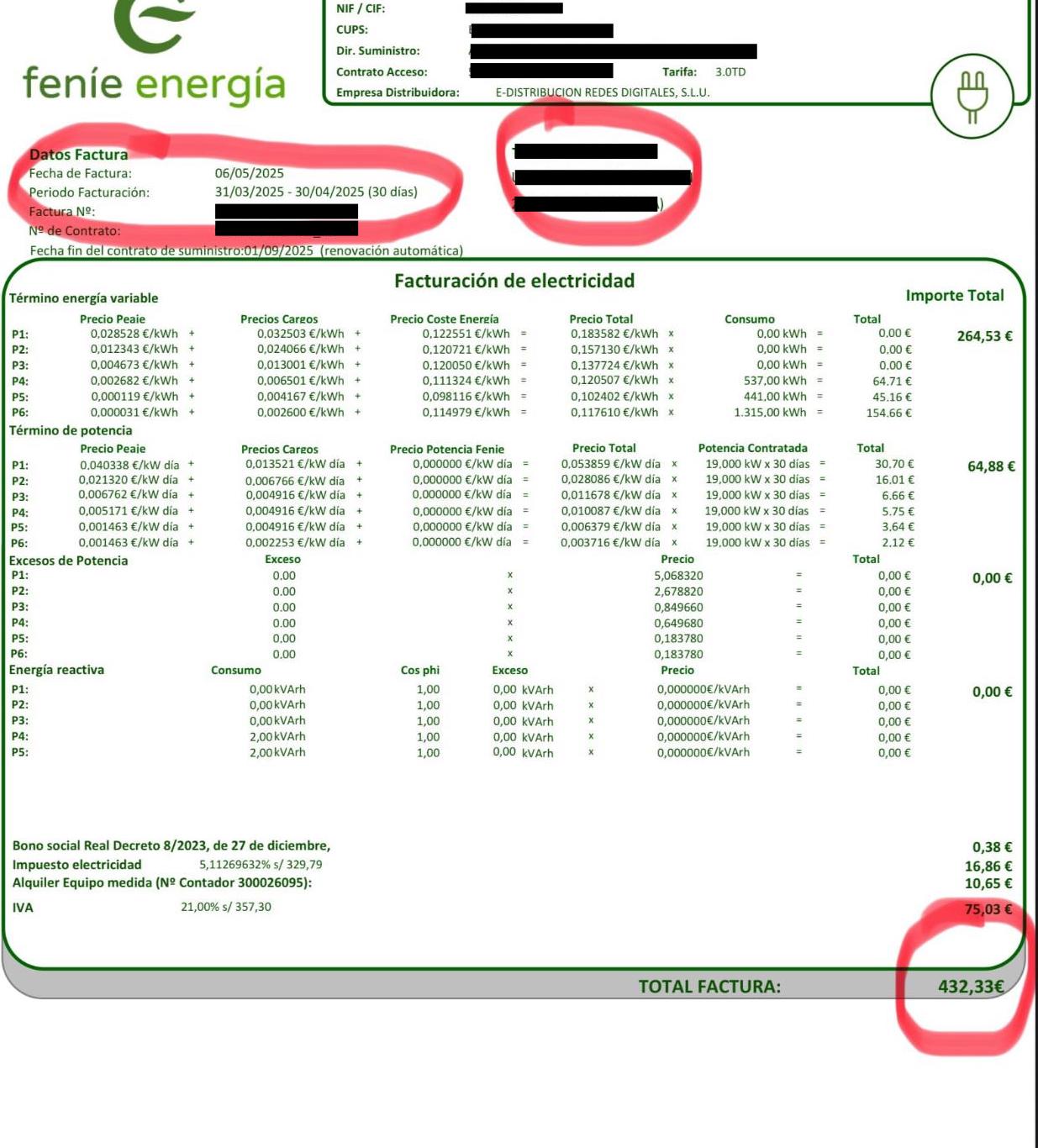
Following an installation of 39 solar panels in Nueva Andalucía, our client found their own virtual battery deal and received a monthly bill of €700. We compared providers and secured a better deal that cut the bill to €432 – without the client consuming less power.
2. Monitor Consumption
Monitoring electricity consumption means tracking how much energy your household is using compared with how much your solar system is producing. This is usually done through an app or an energy meter linked to your inverter.
By monitoring consumption, you can:
- See when your home is using the most electricity.
- Identify wasted energy.
- Adjust usage habits.
Monitoring is crucial to maximise your savings month-to-month.
Most solar installers in Spain leave monitoring in the hands of their clients – but at Marblanc Solar, we offer to do the investigation for you.
For two weeks after installation, we monitor your consumption and system output. This allows us to fine-tune usage and, for example, set up plug timers to shift high-power appliance usage into peak solar hours to maximise your savings.

3. Warranties
Equipment warranties are the guarantees provided by the manufacturers of the main system components. These cover the solar panels, inverter, and any additional equipment such as solar batteries.
Panels often come with warranties of 15–30 years.
Installers highlight these warranties because they offer homeowners peace of mind that their investment is protected for the full expected lifetime of the system. If a component fails within the warranty period, the manufacturer is obliged to repair or replace it.
But there’s a problem here.
What if it’s other parts of your system that fail?
Many solar energy companies stop at equipment warranties – but Marblanc Solar includes a 25-year workmanship warranty. During this time, we are liable to fix or replace any parts of your solar power installation should it malfunction or underperform through no fault of your own.
4. Servicing
Solar panel servicing refers to the ongoing maintenance and technical checks carried out after your system has been installed. Servicing is especially important in the early stages, because solar inverters, batteries, and the wider system need to be configured to deliver optimal performance.
One of the most common complaints we hear from homeowners is that, as soon as an issue arises, their installer is unwilling to help or stops returning calls.
This can happen without servicing agreements in place.
It’s particularly common when a subcontractor is brought in for the installation.
At Marblanc Solar, we avoid these issues by offering a servicing agreement for the first three years. You’ll get an annual inspection by a qualified electrician. This ensures your system continues to perform safely and efficiently long after installation.
You’ll also have a direct WhatsApp channel to our owners to ask for urgent response to issues – and we’ve even sent electricians out at 11pm on a Sunday to resolve them.

In our experience, the post-installation services are what help homeowners in Spain get maximum savings from their solar panel installation.
Estimate the Costs of a Solar Panel Installation in Spain with our Online Calculator
When it comes to solar panels in Spain, the cheapest quote isn’t always the best-value investment. As we’ve seen, cutting corners on materials, labour, or legalisation can lead to higher electricity bills and even serious safety risks.
At Marblanc Solar, we treat every installation as a 25-year investment.
That’s why our quotes include not just panels and inverters, but also the post-installation services that maximise your savings year after year. From monitoring and annual servicing to 25-year workmanship warranties, we build long-term value into every system we install.
Would you like to know what a solar panel installation – with all these additional services built in – could cost for your property?
The team at Marblanc Solar built an online solar break-even calculator to help you answer that question. In just 2-3 minutes it will tell you your:
- Estimated break-even period
- Estimated annual electricity savings for the next 10 years
- Estimated installation cost
Click below to get started.
Want an Instant Cost Estimation?
Want to save time figuring out your own expected solar installation cost?
In 1-2 minutes, our online solar calculator will estimate your:
Installation cost
Annual electricity savings for the next 10 years
Break-even period
Click below to get started.
Solar calculator